
December 13, 2024
Author: Canadian Smart Drivers
If you’ve ever been stuck behind a school bus at a railway crossing in Canada, watching it come to a full stop even when the tracks look completely clear, you’ve probably wondered why. Is it really necessary? The answer is a definitive yes, and the reasons run deep: legal obligation, physical limitations of buses, and a tragedy that changed North American transportation safety forever.
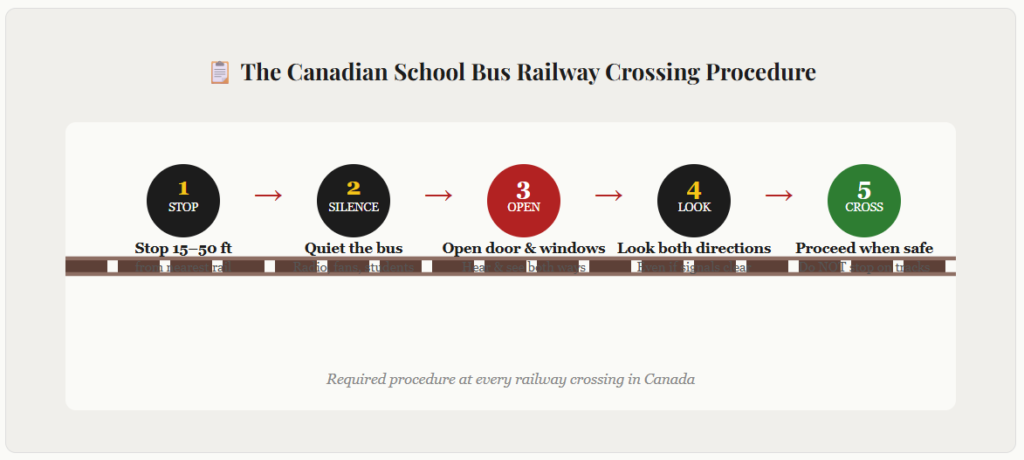
School buses carry some of our most vulnerable passengers, and in Canada, protecting children on the road is not just a priority – it is the law. At every railway crossing, the driver must stop between 15 and 50 feet from the nearest rail, open the door and windows, and listen carefully for any approaching train before proceeding. This applies even when no train is visible, and even when crossing signals are active.
The Tragedy That Changed Everything
On the morning of December 1, 1938, a school bus driven by Farrold Silcox was headed toward Jordan High School in South Jordan, Utah. A thick fog had settled over the area that morning, reducing visibility dramatically. As the bus approached the railway crossing, a freight train known as “The Flying Ute”, pulling 80 cars and travelling at approximately 80 km/h (50 mph), was closing in on the same crossing. By the time the train’s engineer spotted the bus, there was no time to stop.
The collision killed 24 people, including driver Farrold Silcox and 23 students. Fifteen students survived, but with serious injuries. It remains the worst railway crossing accident involving a school bus in U.S. history, and the tragedy that directly gave rise to the safety laws still in place across Canada today.
“The crash was not the result of recklessness, it was the result of a system that had no mandatory safeguards. After 1938, that changed permanently.”
Following this disaster, transportation authorities across North America moved quickly to pass laws requiring all school bus drivers to stop at every railway crossing, open doors and windows, and physically look and listen in both directions before proceeding. These rules were eventually adopted across Canada and remain in effect today.
It’s the Law – In Canada and Across North America
In Canada, provincial Highway Traffic Acts mandate that school bus drivers come to a complete stop before every railway crossing, no closer than 5 metres (about 15 feet) from the nearest rail, before looking and listening in both directions.
This requirement applies regardless of whether warning signals are active, whether the driver knows the route well, or whether the tracks appear completely clear. Signal systems can and do malfunction, and a seemingly safe crossing can turn dangerous within seconds. Under Canadian law, failure to comply is a serious traffic offence.
Why Do School Buses Stop at Railroad Crossings Even If No Train Is Coming?
This is one of the most common questions Canadians ask when watching a school bus at a quiet crossing. The answer comes down to three realities that make buses uniquely vulnerable at railway crossings.
- Signal Systems Can Fail: Railway crossing signals, bells, lights, and barriers are mechanical systems. They can malfunction due to weather, power issues, or technical faults. Opening the door allows the driver to hear a train the signals may have missed.
- Buses Are Large and Slow to Cross: A school bus is long, heavy, and slow to accelerate. Once it begins crossing, it commits to the full length of the track, taking far longer than a regular car. There is no room for error.
- Canadian Weather Reduces Visibility: Snow, fog, freezing rain, and wind are all common across Canada and can drastically reduce how far a driver can see down the tracks. Opening the door removes the sound barrier of the bus cab.
- The Stakes Are Extremely High: A single school bus can carry 72 or more children. The consequence of a train collision is catastrophic and irreversible. The brief stop is a small price compared to the risk it eliminates.
Why Do School Buses Open Their Doors at Railroad Tracks?
Opening the service door is not an accident. It’s a deliberate auditory safety measure. A school bus cab is surprisingly effective at blocking outside sound, making it difficult for drivers to hear what is happening beyond the windows. By opening the door, the driver can hear an approaching train that might not yet be visible around a curve, behind trees, or through a snowstorm.
In rural parts of Canada, especially, railway crossings often lack advanced warning systems. The open door is the driver’s last line of defence against a train that the signals may have failed to detect. Some provinces also require windows to be opened for the same reason.
Think of it this way: the bus itself creates a sound bubble. Opening the door pops that bubble and connects the driver directly to the environment around them, a simple action that has saved countless lives.
Why Do Buses Stop at Railroad Crossings That Have Barriers?
Even at fully equipped crossings with flashing lights, bells, and physical barriers, Canadian school buses are still legally required to stop. Barriers are a warning tool, not a guarantee. They have failed due to electrical faults, mechanical jams, ice build-up, and sensor errors, particularly during harsh Canadian winters.
That is why the stop-look-listen process must always be completed by the driver, independent of any signals. The safety of the children on board cannot depend on a single piece of equipment functioning correctly.
School Bus vs. Regular Vehicle at Railway Crossings
Many Canadians wonder why school buses have stricter requirements than regular cars. The comparison below shows just how different these two situations are at a railway crossing.
Do School Buses Have to Stop at Railroad Tracks Even When Empty?
Yes. In most Canadian provinces, the rule applies to the vehicle category, not whether it currently has passengers. A school bus must stop at all railway crossings whenever it is operating on the road, whether it is carrying a full load of children or returning to the depot empty.
This consistency is important because it keeps the habit ingrained in the driver. Safety routines that only apply “sometimes” are more prone to being skipped during moments of fatigue, distraction, or time pressure. The rule being universal means it is always followed.
What Should You Do When Stuck Behind a School Bus at a Railway Crossing?
As a Canadian driver, here’s what to keep in mind when you find yourself behind a school bus at a crossing. First, maintain a safe following distance and do not tailgate. When the bus signals and slows, slow down with it and come to a stop behind it, leaving enough space.
Do not honk, flash your lights, or pressure the bus driver in any way. The procedure takes only 20–30 seconds and is legally required. Once the bus has completed its check and begins moving forward, wait until it has fully cleared the crossing before you proceed, especially if you are driving a shorter vehicle that can cross more quickly.
Frequently Asked Questions
Why do school buses stop at railroad crossings?
It is the law in Canada, every bus must stop, check, and confirm the tracks are clear before crossing, no matter what.
Why do busses stop at train tracks even when no train is coming?
Because railway signals can fail without warning, the driver must always check independently rather than trusting the signals alone.
Why do school buses stop at railroad crossings and open their doors?
Opening the door lets the driver hear an approaching train that the signals may have missed or that is not yet visible.
Why do school buses stop at railroad crossings that have barriers?
Barriers can fail due to ice, electrical faults, or sensor errors, so the driver must always do their own check regardless.
Why do buses stop at railroad crossings even when empty?
The rule applies to the vehicle, not the passengers, an empty school bus must still stop at every railway crossing by law.
Why do school buses have to open their doors when at a railroad crossing?
The bus cab blocks the sound outside, so opening the door allows the driver to hear any train approaching from either direction.
The Next Time You’re Behind a School Bus at a Crossing…
Those 20 to 30 seconds feel like a small inconvenience when you’re running late. But they represent one of the most carefully designed safety protocols in Canadian transportation law, a protocol that exists because we once learned the hard way what happens when it doesn’t.
Every time a Canadian school bus driver opens that door, scans the tracks, and listens for a train before crossing, they are following a procedure that has protected thousands of children from a catastrophe just like the one in 1938. It is quiet, unhurried, and completely necessary.
At Canadian Smart Drivers, we teach our students not just the rules of the road, but the reasons behind them. Understanding why a law exists makes it far easier to follow it confidently and safely. Whether you are preparing for your G1, working toward your full licence, or looking to become a more aware driver on Canadian roads, we are here to help.
Call us at 519-697-8633 or email info@canadiansmartdrivers.ca to get started.